




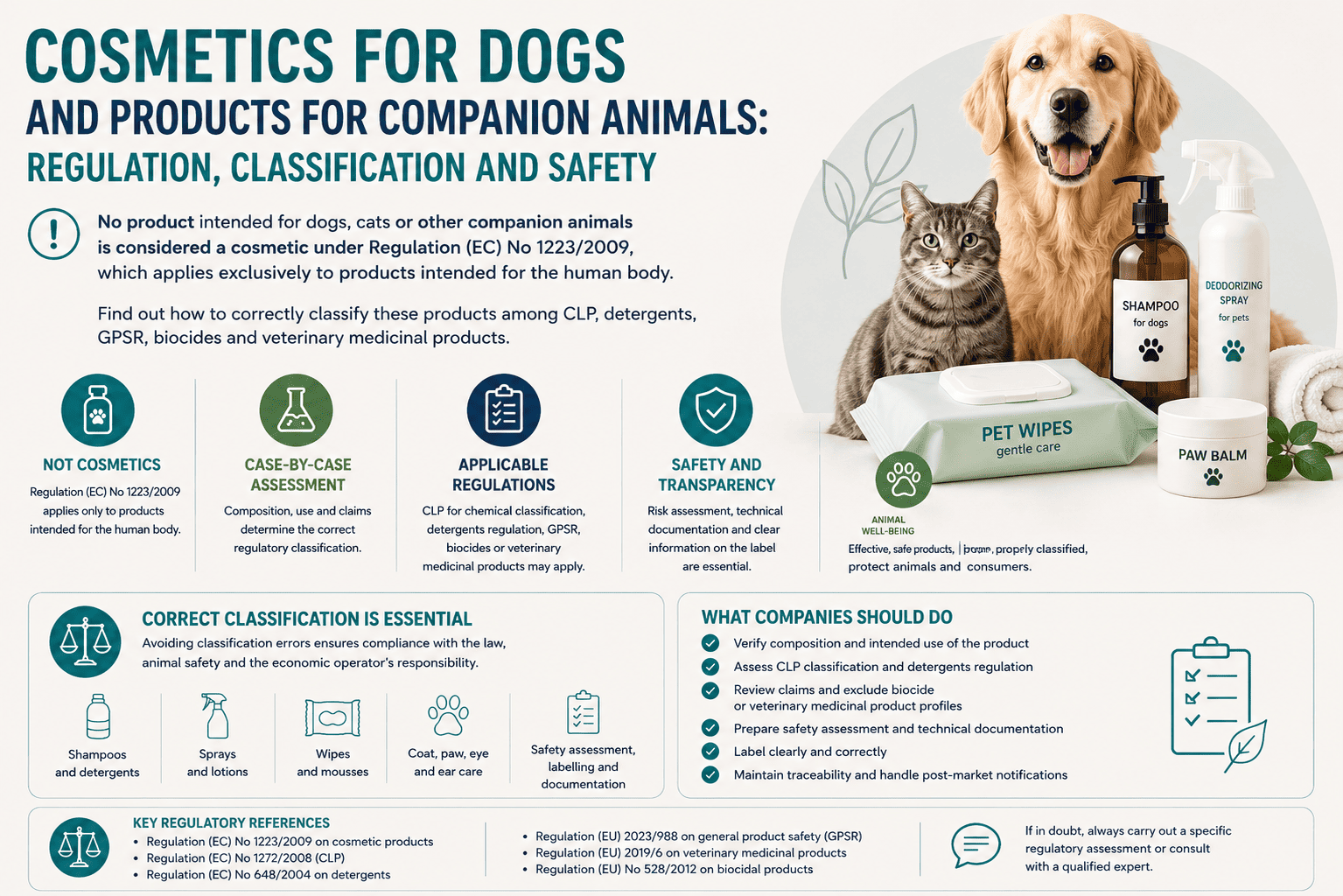
Cosmetics for Dogs and Products for Companion Animals: Regulation, Classification and Safety
Cosmetics for Dogs and Products for Companion Animals: Regulation, Classification and Safety
Products for the hygiene and care of companion animals, especially those intended for dogs, are increasingly common on the market: shampoos, conditioners, mousses, deodorising sprays, wipes, coat lotions and products for paws, eyes and ears are often commercially presented as “cosmetics for dogs”, “veterinary cosmetics” or pet-care products.
However, from a regulatory point of view, the use of the term “cosmetic” must be assessed carefully. Regulation (EC) No 1223/2009 defines a cosmetic product as a substance or mixture intended to be placed in contact with the external parts of the human body, or with the teeth and the mucous membranes of the oral cavity, mainly for cleaning, perfuming, changing appearance, protecting, keeping in good condition or correcting body odours.
As a consequence, a product intended for dogs, cats or other companion animals does not automatically fall within the scope of the EU Cosmetics Regulation, even if it performs a function similar to a shampoo, cream or lotion intended for human use.
What Can Be Found on the Market
There are many products on the market intended for the care of companion animals: dog shampoos, conditioners, coat sprays, cleansing wipes, deodorising products, leave-on mousses and products for the cleaning of paws, eyes and ears.
These products are often marketed using terminology close to the cosmetic sector, such as “cosmetics for dogs”, “veterinary cosmetics”, “grooming products”, “coat-care products” or “animal hygiene products”.
This approach is understandable from a commercial perspective, as it helps consumers identify the function of the product. However, it should not lead to the automatic application of the cosmetic legislation intended for products for human use.
Does the EU Cosmetics Regulation Apply to Pet-Care Products?
In general, no.
Regulation (EC) No 1223/2009 regulates cosmetic products intended for the human body. The legal definition does not include products intended for animals. Therefore, a dog shampoo or a wipe for companion animals should not automatically be treated as a cosmetic product under the EU Cosmetics Regulation.
This means that typical obligations for human cosmetic products do not automatically apply, such as:
- Product Information File under Article 11 of Regulation (EC) No 1223/2009;
- Cosmetic Product Safety Report under Annex I of Regulation (EC) No 1223/2009;
- CPNP notification;
- cosmetic Responsible Person;
- cosmetic labelling under Article 19;
- assessment of cosmetic claims under Regulation (EU) No 655/2013.
This does not mean that the product has no obligations. It means that the correct regulatory classification must be identified based on composition, function, method of use, target animal species and claims.
Products for Animals: Cosmetics, Detergents or Chemical Mixtures?
The most delicate point is classification.
A shampoo for dogs or for companion animals is often a mixture containing surfactants, fragrance, preservatives, conditioning agents and other functional ingredients. If the main function is to wash or clean the animal’s skin and coat, the possible applicability of detergent legislation should also be assessed.
Regulation (EC) No 648/2004 defines a detergent as any substance or preparation containing soaps and/or other surfactants intended for washing and cleaning processes.
Furthermore, when a product does not fall within the scope of the Cosmetics Regulation, the classification of the mixture under the CLP Regulation must be assessed. The CLP Regulation concerns the classification, labelling and packaging of substances and mixtures and aims to ensure that chemical hazards are properly communicated to workers and consumers.
If the mixture is classified as hazardous, pictograms, signal words, hazard statements, precautionary statements, UFI, poison centre notification and a Safety Data Sheet may be required, depending on the applicable case.
The Role of the GPSR
Products for dogs and, more generally, pet-care products sold to final consumers are free-sale products intended to be purchased and used by consumers.
In the absence of specific sector legislation fully applicable to the product, Regulation (EU) 2023/988 on general product safety, known as the GPSR, may also be relevant. The General Product Safety Regulation aims to ensure that only safe products are available on the market.
In the case of products for companion animals, safety should be assessed by considering the characteristics of the product, its composition, packaging, instructions for use, warnings and reasonably foreseeable risks for both the animal and the person applying the product.
Claims and Borderline Risk
Many pet-care products remain within the area of hygiene, cleaning and ordinary coat care. However, some claims may move the product towards more complex regulatory categories.
Claims requiring particular attention include:
- anti-itch;
- against dermatitis;
- antifungal;
- antibacterial;
- disinfectant;
- antiparasitic;
- repellent;
- against fleas, ticks or mites;
- treatment of skin infections;
- treatment of dermatological conditions;
- regeneration of damaged skin;
- pharmacological or therapeutic action.
If the product is presented as suitable for treating or preventing a disease in animals, or if it is intended to restore, correct or modify physiological functions by exerting a pharmacological, immunological or metabolic action, it may be necessary to assess whether it falls within the scope of veterinary medicinal products. Regulation (EU) 2019/6 includes, within the concept of veterinary medicinal product, products presented as having properties for treating or preventing disease in animals.
In addition, if the product is intended to control harmful organisms, microorganisms, insects or parasites, it may also be necessary to assess possible classification as a biocidal product. Regulation (EU) No 528/2012 defines a biocidal product by reference to substances or mixtures intended to destroy, deter, render harmless, prevent the action of, or otherwise control harmful organisms by means other than mere physical or mechanical action.
Our Opinion on the Correct Classification
In our opinion, the expression “cosmetics for dogs” may be useful from a commercial and SEO perspective, because it is immediately understandable for companies and consumers. However, from a regulatory point of view, it would be more accurate to refer to hygiene and care products for companion animals or pet-care products.
The correct classification should start from three questions:
- Is the product intended exclusively for hygiene, cleaning, perfuming or aesthetic care of the animal’s coat and skin?
- Does the formula contain substances or mixtures requiring CLP classification or other chemical obligations?
- Do the claims suggest a therapeutic, antiparasitic, antimicrobial, disinfectant or other action linked to veterinary medicinal products or biocides?
If the product is a shampoo, mousse, wipe or spray intended only for ordinary cleaning and care of the animal, the most prudent classification is not that of a human cosmetic, but that of a free-sale product for companion animals, to be assessed according to composition, function and claims.
If, on the other hand, the product claims effects on diseases, infections, parasites, dermatitis or skin disorders, the classification must be assessed in more detail, as the product may fall outside the area of simple animal hygiene.
Is It Correct to Prepare a Cosmetic PIF for Pet-Care Products?
In our opinion, it is not correct to present the cosmetic PIF as a legal obligation for a product intended for companion animals.
The PIF required under Regulation (EC) No 1223/2009 concerns cosmetic products intended for human use. For a product intended for dogs, cats or other animals, it may be useful to prepare a technical safety file inspired by the logic of the cosmetic PIF, but without confusing it with the PIF required by EU cosmetic legislation.
A technical file for pet-care products may include:
- product description;
- qualitative and quantitative formula;
- function and directions for use;
- target animal species;
- assessment of ingredients;
- CLP assessment of the mixture;
- raw material documentation;
- microbiological data, where relevant;
- stability data;
- packaging compatibility;
- assessment of warnings;
- claims review;
- safety assessment for the animal and the user;
- label and instructions for use.
This approach makes it possible to demonstrate a technical and documented approach to safety, without assigning the product to a cosmetic classification that is not expressly provided for by the legislation.
Labelling of Products for Companion Animals
The label of a pet-care product should be clear, complete and consistent with the actual function of the product.
In particular, the following aspects should be assessed:
- product name;
- target animal species;
- actual function of the product;
- directions for use;
- whether the product is rinse-off or leave-on;
- nominal quantity;
- batch number;
- shelf life or expiry date, where applicable;
- details of the operator responsible for placing the product on the market;
- ingredients or components according to the applicable legislation;
- any CLP pictograms and statements, where necessary;
- warnings for the animal;
- warnings for the user;
- instructions to avoid eyes, mucous membranes, ingestion or damaged skin;
- storage conditions;
- consistent and non-therapeutic claims.
The label should not lead consumers to believe that the product has curative, pharmacological, antiparasitic or disinfectant effects if such effects are not supported by the correct regulatory classification.
What Companies, Importers and Distributors Should Do
Companies producing, importing or distributing products for companion animals should avoid automatic classifications and carry out a preliminary assessment of the product.
The recommended activities include:
- verifying the actual intended use;
- analysing the composition and classification of the mixture;
- assessing the applicability of the CLP Regulation;
- assessing the possible applicability of detergent legislation;
- reviewing claims, commercial descriptions and promotional material;
- excluding possible profiles as veterinary medicinal products or biocides;
- preparing a technical safety assessment;
- drafting a consistent technical file;
- reviewing labels and warnings;
- checking supplier documentation;
- maintaining traceability and managing any post-market reports.
Conclusion
The market for products for companion animals often uses the language of cosmetics, especially for products such as dog shampoos, wipes, mousses and coat sprays. However, the correct regulatory classification cannot be based only on commercial terminology.
A product intended for dogs, cats or other companion animals does not automatically become a cosmetic product under Regulation (EC) No 1223/2009, because that Regulation applies to products intended for the human body.
The correct approach is to assess the product case by case, considering formula, function, method of use, animal species, claims and reasonably foreseeable risks. For ordinary hygiene and care products for companion animals, the most robust approach is to prepare specific technical safety documentation for the pet-care product, while also checking CLP obligations, possible detergent requirements, general product safety and labelling.
In this way, products for the care of companion animals can be marketed more consciously, avoiding both the improper application of cosmetic legislation and the risk of falling into more complex categories such as veterinary medicinal products or biocides.Products for the hygiene and care of companion animals, especially those intended for dogs, are increasingly common on the market: shampoos, conditioners, mousses, deodorising sprays, wipes, coat lotions and products for paws, eyes and ears are often commercially presented as “cosmetics for dogs”, “veterinary cosmetics” or pet-care products.
However, from a regulatory point of view, the use of the term “cosmetic” must be assessed carefully. Regulation (EC) No 1223/2009 defines a cosmetic product as a substance or mixture intended to be placed in contact with the external parts of the human body, or with the teeth and the mucous membranes of the oral cavity, mainly for cleaning, perfuming, changing appearance, protecting, keeping in good condition or correcting body odours.
As a consequence, a product intended for dogs, cats or other companion animals does not automatically fall within the scope of the EU Cosmetics Regulation, even if it performs a function similar to a shampoo, cream or lotion intended for human use.
What Can Be Found on the Market
There are many products on the market intended for the care of companion animals: dog shampoos, conditioners, coat sprays, cleansing wipes, deodorising products, leave-on mousses and products for the cleaning of paws, eyes and ears.
These products are often marketed using terminology close to the cosmetic sector, such as “cosmetics for dogs”, “veterinary cosmetics”, “grooming products”, “coat-care products” or “animal hygiene products”.
This approach is understandable from a commercial perspective, as it helps consumers identify the function of the product. However, it should not lead to the automatic application of the cosmetic legislation intended for products for human use.
Does the EU Cosmetics Regulation Apply to Pet-Care Products?
In general, no.
Regulation (EC) No 1223/2009 regulates cosmetic products intended for the human body. The legal definition does not include products intended for animals. Therefore, a dog shampoo or a wipe for companion animals should not automatically be treated as a cosmetic product under the EU Cosmetics Regulation.
This means that typical obligations for human cosmetic products do not automatically apply, such as:
- Product Information File under Article 11 of Regulation (EC) No 1223/2009;
- Cosmetic Product Safety Report under Annex I of Regulation (EC) No 1223/2009;
- CPNP notification;
- cosmetic Responsible Person;
- cosmetic labelling under Article 19;
- assessment of cosmetic claims under Regulation (EU) No 655/2013.
This does not mean that the product has no obligations. It means that the correct regulatory classification must be identified based on composition, function, method of use, target animal species and claims.
Products for Animals: Cosmetics, Detergents or Chemical Mixtures?
The most delicate point is classification.
A shampoo for dogs or for companion animals is often a mixture containing surfactants, fragrance, preservatives, conditioning agents and other functional ingredients. If the main function is to wash or clean the animal’s skin and coat, the possible applicability of detergent legislation should also be assessed.
Regulation (EC) No 648/2004 defines a detergent as any substance or preparation containing soaps and/or other surfactants intended for washing and cleaning processes.
Furthermore, when a product does not fall within the scope of the Cosmetics Regulation, the classification of the mixture under the CLP Regulation must be assessed. The CLP Regulation concerns the classification, labelling and packaging of substances and mixtures and aims to ensure that chemical hazards are properly communicated to workers and consumers.
If the mixture is classified as hazardous, pictograms, signal words, hazard statements, precautionary statements, UFI, poison centre notification and a Safety Data Sheet may be required, depending on the applicable case.
The Role of the GPSR
Products for dogs and, more generally, pet-care products sold to final consumers are free-sale products intended to be purchased and used by consumers.
In the absence of specific sector legislation fully applicable to the product, Regulation (EU) 2023/988 on general product safety, known as the GPSR, may also be relevant. The General Product Safety Regulation aims to ensure that only safe products are available on the market.
In the case of products for companion animals, safety should be assessed by considering the characteristics of the product, its composition, packaging, instructions for use, warnings and reasonably foreseeable risks for both the animal and the person applying the product.
Claims and Borderline Risk
Many pet-care products remain within the area of hygiene, cleaning and ordinary coat care. However, some claims may move the product towards more complex regulatory categories.
Claims requiring particular attention include:
- anti-itch;
- against dermatitis;
- antifungal;
- antibacterial;
- disinfectant;
- antiparasitic;
- repellent;
- against fleas, ticks or mites;
- treatment of skin infections;
- treatment of dermatological conditions;
- regeneration of damaged skin;
- pharmacological or therapeutic action.
If the product is presented as suitable for treating or preventing a disease in animals, or if it is intended to restore, correct or modify physiological functions by exerting a pharmacological, immunological or metabolic action, it may be necessary to assess whether it falls within the scope of veterinary medicinal products. Regulation (EU) 2019/6 includes, within the concept of veterinary medicinal product, products presented as having properties for treating or preventing disease in animals.
In addition, if the product is intended to control harmful organisms, microorganisms, insects or parasites, it may also be necessary to assess possible classification as a biocidal product. Regulation (EU) No 528/2012 defines a biocidal product by reference to substances or mixtures intended to destroy, deter, render harmless, prevent the action of, or otherwise control harmful organisms by means other than mere physical or mechanical action.
My Opinion on the Correct Classification
In my opinion, the expression “cosmetics for dogs” may be useful from a commercial and SEO perspective, because it is immediately understandable for companies and consumers. However, from a regulatory point of view, it would be more accurate to refer to hygiene and care products for companion animals or pet-care products.
The correct classification should start from three questions:
- Is the product intended exclusively for hygiene, cleaning, perfuming or aesthetic care of the animal’s coat and skin?
- Does the formula contain substances or mixtures requiring CLP classification or other chemical obligations?
- Do the claims suggest a therapeutic, antiparasitic, antimicrobial, disinfectant or other action linked to veterinary medicinal products or biocides?
If the product is a shampoo, mousse, wipe or spray intended only for ordinary cleaning and care of the animal, the most prudent classification is not that of a human cosmetic, but that of a free-sale product for companion animals, to be assessed according to composition, function and claims.
If, on the other hand, the product claims effects on diseases, infections, parasites, dermatitis or skin disorders, the classification must be assessed in more detail, as the product may fall outside the area of simple animal hygiene.
Is It Correct to Prepare a Cosmetic PIF for Pet-Care Products?
In my opinion, it is not correct to present the cosmetic PIF as a legal obligation for a product intended for companion animals.
The PIF required under Regulation (EC) No 1223/2009 concerns cosmetic products intended for human use. For a product intended for dogs, cats or other animals, it may be useful to prepare a technical safety file inspired by the logic of the cosmetic PIF, but without confusing it with the PIF required by EU cosmetic legislation.
A technical file for pet-care products may include:
- product description;
- qualitative and quantitative formula;
- function and directions for use;
- target animal species;
- assessment of ingredients;
- CLP assessment of the mixture;
- raw material documentation;
- microbiological data, where relevant;
- stability data;
- packaging compatibility;
- assessment of warnings;
- claims review;
- safety assessment for the animal and the user;
- label and instructions for use.
This approach makes it possible to demonstrate a technical and documented approach to safety, without assigning the product to a cosmetic classification that is not expressly provided for by the legislation.
Labelling of Products for Companion Animals
The label of a pet-care product should be clear, complete and consistent with the actual function of the product.
In particular, the following aspects should be assessed:
- product name;
- target animal species;
- actual function of the product;
- directions for use;
- whether the product is rinse-off or leave-on;
- nominal quantity;
- batch number;
- shelf life or expiry date, where applicable;
- details of the operator responsible for placing the product on the market;
- ingredients or components according to the applicable legislation;
- any CLP pictograms and statements, where necessary;
- warnings for the animal;
- warnings for the user;
- instructions to avoid eyes, mucous membranes, ingestion or damaged skin;
- storage conditions;
- consistent and non-therapeutic claims.
The label should not lead consumers to believe that the product has curative, pharmacological, antiparasitic or disinfectant effects if such effects are not supported by the correct regulatory classification.
What Companies, Importers and Distributors Should Do
Companies producing, importing or distributing products for companion animals should avoid automatic classifications and carry out a preliminary assessment of the product.
The recommended activities include:
- verifying the actual intended use;
- analysing the composition and classification of the mixture;
- assessing the applicability of the CLP Regulation;
- assessing the possible applicability of detergent legislation;
- reviewing claims, commercial descriptions and promotional material;
- excluding possible profiles as veterinary medicinal products or biocides;
- preparing a technical safety assessment;
- drafting a consistent technical file;
- reviewing labels and warnings;
- checking supplier documentation;
- maintaining traceability and managing any post-market reports.
Conclusion
The market for products for companion animals often uses the language of cosmetics, especially for products such as dog shampoos, wipes, mousses and coat sprays. However, the correct regulatory classification cannot be based only on commercial terminology.
A product intended for dogs, cats or other companion animals does not automatically become a cosmetic product under Regulation (EC) No 1223/2009, because that Regulation applies to products intended for the human body.
The correct approach is to assess the product case by case, considering formula, function, method of use, animal species, claims and reasonably foreseeable risks. For ordinary hygiene and care products for companion animals, the most robust approach is to prepare specific technical safety documentation for the pet-care product, while also checking CLP obligations, possible detergent requirements, general product safety and labelling.
In this way, products for the care of companion animals can be marketed more consciously, avoiding both the improper application of cosmetic legislation and the risk of falling into more complex categories such as veterinary medicinal products or biocides.