





REACH, CLP and SDS Consulting
The European Union REACH Regulation was adopted to improve the protection of human health and the environment from the risks that may arise from chemical substances.
REACH applies in principle to all chemical substances: not only those used in industrial processes, but also those used in everyday life, such as cleaning products and paints, as well as substances present in articles such as clothing, furniture and household appliances. For this reason, the regulation has an impact on the majority of companies operating within the EU.
How does REACH work?
REACH establishes procedures for gathering and evaluating information on the properties of substances and the hazards arising from them. Companies are required to register substances and, for this purpose, must cooperate with the other companies registering the same substance.
REACH concerns a wide range of companies operating in many sectors, including some that may not think they are involved in the use of chemical substances. In general, the following roles are relevant under REACH:
- Manufacturer: anyone producing chemicals, either for their own use or to supply others, is likely to have important responsibilities under REACH.
- Importer: anyone purchasing goods from outside the EU/EEA is likely to have obligations under REACH. Purchased goods may be individual chemicals, mixtures for resale or finished goods such as clothing, furniture or plastic products.
- Downstream users: most companies use chemicals, sometimes without even realising it; therefore, businesses need to verify their obligations whenever they use any chemical substance in their industrial or professional activity, as they may have responsibilities under REACH.
- Companies established outside the EU: businesses established outside the EU are not bound by REACH obligations, even if they export their products into the customs territory of the European Union. REACH obligations, such as registration, fall on importers established in the EU or on the only representative established in the EU of a non-EU manufacturer.
CLP – Classification, labelling and packaging of substances and mixtures
Regulation (EC) No 1272/2008 on CLP aligns previous EU legislation with the GHS (Globally Harmonised System of Classification and Labelling of Chemicals), a United Nations system for identifying hazardous chemicals and informing users about those hazards. The CLP Regulation entered into force on 20 January 2009 and progressively replaced the Dangerous Substances Directive (67/548/EEC) and the Dangerous Preparations Directive (1999/45/EC). Both directives were repealed on 1 June 2015.
The hazards arising from chemicals are communicated through signal words and pictograms shown on labels and safety data sheets.
The new red-framed pictograms have replaced the well-known orange hazard symbols.
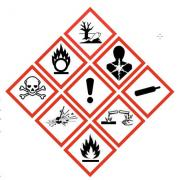
Old terminology has been replaced by new terms:
- mixtures instead of preparations;
- “hazardous” instead of “dangerous” in English;
- pictograms instead of symbols;
- hazard statements instead of risk phrases;
- precautionary statements instead of safety phrases.
- Hazard indications are replaced by signal words such as Danger and Warning.
Classification
In most cases, suppliers must decide on the classification of a substance or a mixture. This process is called self-classification. In some cases, the decision on the classification of substances is taken at EU level in order to ensure proper risk management. Member States, manufacturers, importers and downstream users may propose the classification and labelling of a substance to be harmonised throughout the European Union.
This usually concerns the most hazardous substances: carcinogenic, mutagenic and toxic for reproduction substances, respiratory sensitisers, biocides or plant protection products. All classifications previously harmonised under the old legislation were converted into harmonised CLP classifications. Suppliers are required to apply this harmonised classification and labelling.
Labelling and packaging
Once the hazardous properties of a substance or mixture have been identified, it must be classified accordingly. Manufacturers, importers, downstream users and distributors, as well as producers and importers of certain specific articles, must communicate the identified hazards to other actors in the supply chain, including consumers.
This is done by labelling the substance or mixture in accordance with the CLP Regulation before placing it on the market, when:
- the substance or mixture is classified as hazardous;
- the mixture contains one or more substances classified as hazardous above a certain threshold;
- the article has explosive properties.
The CLP Regulation defines the content of the label and the organisation of the various label elements.
The packaging of a hazardous chemical must be designed, manufactured and closed in such a way as to prevent any leakage of the contents. Therefore, the packaging materials must be strong, solid and resistant to the damage caused by the contents. A reclosable fastening system must allow the packaging to be closed again several times without leakage of the contents.
SDS (Safety Data Sheets)
Safety data sheets are intended to provide users of chemical substances with the information necessary to protect human health and the environment. Users of chemical substances are companies or individuals within the European Union or the European Economic Area who use a chemical substance, either on its own or within a mixture, for their industrial or professional activities. Safety data sheets are addressed both to workers handling chemical substances and to those responsible for safety. The European regulation laying down the requirements for drafting safety data sheets (SDS) is Regulation (EU) 2020/878.
When is it necessary to provide a safety data sheet?
A safety data sheet must be provided when:
- a substance or mixture is classified as hazardous;
- a substance is persistent, bioaccumulative and toxic (PBT) or very persistent and very bioaccumulative (vPvB); or
- a substance is included in the candidate list for authorisation under REACH for reasons other than those listed above.