




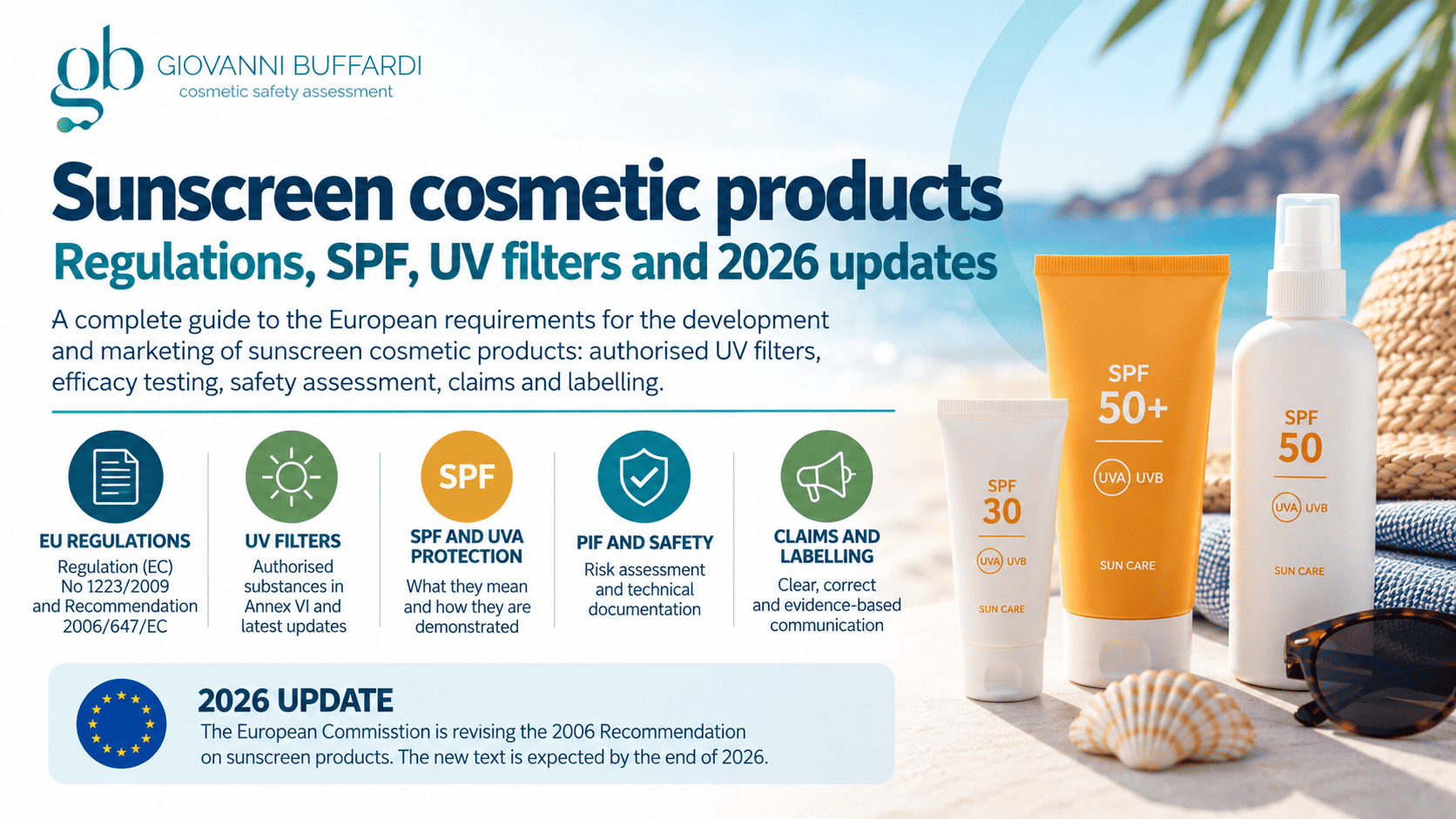
Cosmetic sunscreen products: EU regulations, SPF, UV filters and 2026 updates
Cosmetic sunscreen products are a particularly complex category from a regulatory perspective. Their marketing in the European Union requires simultaneous consideration of formula compliance, the UV filters used, safety assessment, efficacy testing, SPF and UVA protection, claims and labelling.
The regulatory framework is also evolving: in 2026, the revision of the 2006 European Recommendation on sunscreen products is underway, with the aim of adapting it to the scientific and technological developments that have taken place over the last twenty years. The new text is expected by the end of 2026.
Sunscreen products and European legislation
In the European Union, cosmetic sunscreen products intended mainly to protect the skin from UV radiation fall within the scope of Regulation (EC) No 1223/2009.
Commission Recommendation 2006/647/EC defines a sunscreen product as a preparation, such as a cream, oil, gel or spray, intended to be placed in contact with human skin for the exclusive or main purpose of protecting it from UV radiation by absorbing, scattering or reflecting radiation.
As with any other cosmetic product, before being placed on the market a sunscreen product must therefore have a Responsible Person, undergo a safety assessment, have a Product Information File (PIF), comply with labelling requirements and be notified through the CPNP.
These general requirements are complemented by specific requirements relating to the efficacy of sun protection.
UV filters allowed in cosmetic products
One of the main aspects in the formulation of cosmetic sunscreen products concerns the selection and correct concentration of UV filters.
In the European Union, only substances authorised for this function in Annex VI to Regulation (EC) No 1223/2009 may be used, in compliance with the maximum concentrations and any specific conditions or restrictions laid down therein.
The assessment must also consider the possible use of filters in nano form and the type of product. This is particularly important for sprays and aerosols, where potential inhalation exposure must also be evaluated.
UV filter legislation is not static. Substances are periodically reassessed on the basis of new available evidence.
A recent example is 4-Methylbenzylidene Camphor (4-MBC): following the regulatory review, from 1 May 2026 cosmetic products containing this filter may no longer be made available on the European Union market.
Other filters, including Homosalate, Benzophenone-3 and Octocrylene, have also been subject in recent years to assessments and changes to their conditions of use.
For sunscreen products already on the market, it is therefore important not to limit compliance checks to the time of launch, but to carry out periodic monitoring of formulation compliance.
SPF and UVA protection: what must be demonstrated?
The SPF – Sun Protection Factor is the parameter most familiar to consumers, but it cannot be assigned simply on the basis of the quantity or type of UV filters present in the formula.
Product efficacy depends on the formulation system as a whole: concentration and combination of filters, photostability, dispersion, emulsion characteristics, film formation on the skin and interactions between ingredients.
Consequently, the claimed SPF must be supported by testing performed on the finished product.
The European Recommendation identifies low, medium, high and very high protection categories and associates them with the SPF values that may be communicated to consumers: 6 and 10; 15, 20 and 25; 30 and 50; 50+. To claim SPF 50+, for example, the measured value must be at least 60.
Protection cannot, however, be assessed by considering UVB radiation alone.
The Recommendation provides that UVA protection should be at least one third of the claimed SPF and that a critical wavelength of at least 370 nm should be achieved.
Compliance with the relationship between UVA protection and SPF is the basis for the use of the well-known UVA symbol inside a circle on products marketed in the European Union.
SPF testing: towards new in vitro methods
The determination of sunscreen efficacy is undergoing significant technical development.
Among the main international references is ISO 24444 for the in vivo determination of SPF. New standardised in vitro methods have now been added, including ISO 23675:2024, which represents an important development in the possibility of assessing sun protection without relying exclusively on in vivo determination.
This evolution is also one of the reasons why the current European Recommendation, dating back to 2006, needs to be updated.
Claims and labelling of sunscreen products
Correct communication of efficacy is particularly important for sunscreen products.
Consumers may in fact modify their behaviour during sun exposure on the basis of the information provided on the packaging.
The European Recommendation therefore states that claims suggesting complete protection against UV radiation should not be used. Expressions such as “total protection”, “100% UV protection” or “sunblock” are not considered appropriate, since no sunscreen product can provide absolute protection.
Likewise, communication should not suggest that a single application can provide protection regardless of the duration of exposure.
Additional claims such as “water resistant” or “very water resistant” must be supported by adequate experimental evidence.
In general, the criteria laid down in Regulation (EU) No 655/2013 also apply to sunscreen products: every claim must be truthful, supported by adequate evidence and consistent with the actual characteristics of the product.
PIF and safety assessment of sunscreen products
Before marketing, a PIF – Product Information File must be prepared, including the Cosmetic Product Safety Report (CPSR).
The safety assessment of cosmetic sunscreen products requires particular attention to the exposure scenario.
A body sunscreen may be applied over a very large skin surface, several times during the day and in greater amounts than many other leave-on cosmetic products.
The Safety Assessor must therefore carefully consider the amount applied, frequency of use, area of application, target population, exposure to individual ingredients and the characteristics of the cosmetic form.
For spray products, potential inhalation exposure must also be considered, while in the presence of nanomaterials the specific requirements laid down in the Cosmetics Regulation must be verified.
Reports relating to SPF, UVA protection and other efficacy claims are also an essential part of the documentation supporting the product.
The European Recommendation on sunscreen products is changing
One of the most important regulatory developments in 2026 concerns the revision of Recommendation 2006/647/EC.
The European Commission has established a dedicated working group involving representatives of the Commission, competent authorities of the Member States and other stakeholders. The group, active since 2024, aims to update a Recommendation that is now twenty years old.
The revision has become necessary because of advances in photoprotection science, the availability of new testing methods and changes in the market itself.
A particularly interesting issue is the increasing availability of multifunctional products with SPF, such as daily face creams, make-up and other cosmetics in which sun protection is not necessarily the primary function.
Ongoing discussions also concern the communication of UVA and UVB protection levels to consumers and the adaptation of efficacy criteria to new standardised methods. The revision of the Recommendation has also been confirmed in technical industry meetings scheduled during 2026.
The new text is expected by the end of 2026 and may therefore modify some of the technical and communication references that have been used for twenty years in the assessment and presentation of sunscreen products.
Companies developing or marketing products with SPF should therefore closely monitor these developments.
Marketing a sunscreen product in the European Union
The regulatory development of a sunscreen product cannot be reduced to the simple selection of authorised UV filters.
The marketing of cosmetic sunscreen products in the European Union therefore requires an integrated approach covering formulation, efficacy, safety, claims, labelling and regulatory documentation.
Even an apparently limited change to the formulation may affect photoprotective efficacy and make it necessary to reassess previously performed tests.
For sunscreen products, perhaps more than for many other cosmetic categories, claimed efficacy and consumer safety are closely connected.
Regulatory assessment should therefore accompany product development from its earliest stages, rather than addressing compliance issues only after formulation and testing have been completed.
Main references
Regulation (EC) No 1223/2009 on cosmetic products; Commission Recommendation 2006/647/EC on the efficacy of sunscreen products and the claims made relating thereto; Regulation (EU) No 655/2013 on common criteria for cosmetic claims; Regulation (EU) 2024/996; ISO 24444; ISO 24443; ISO 23675:2024; Opinions and Scientific Advice of the Scientific Committee on Consumer Safety (SCCS).