




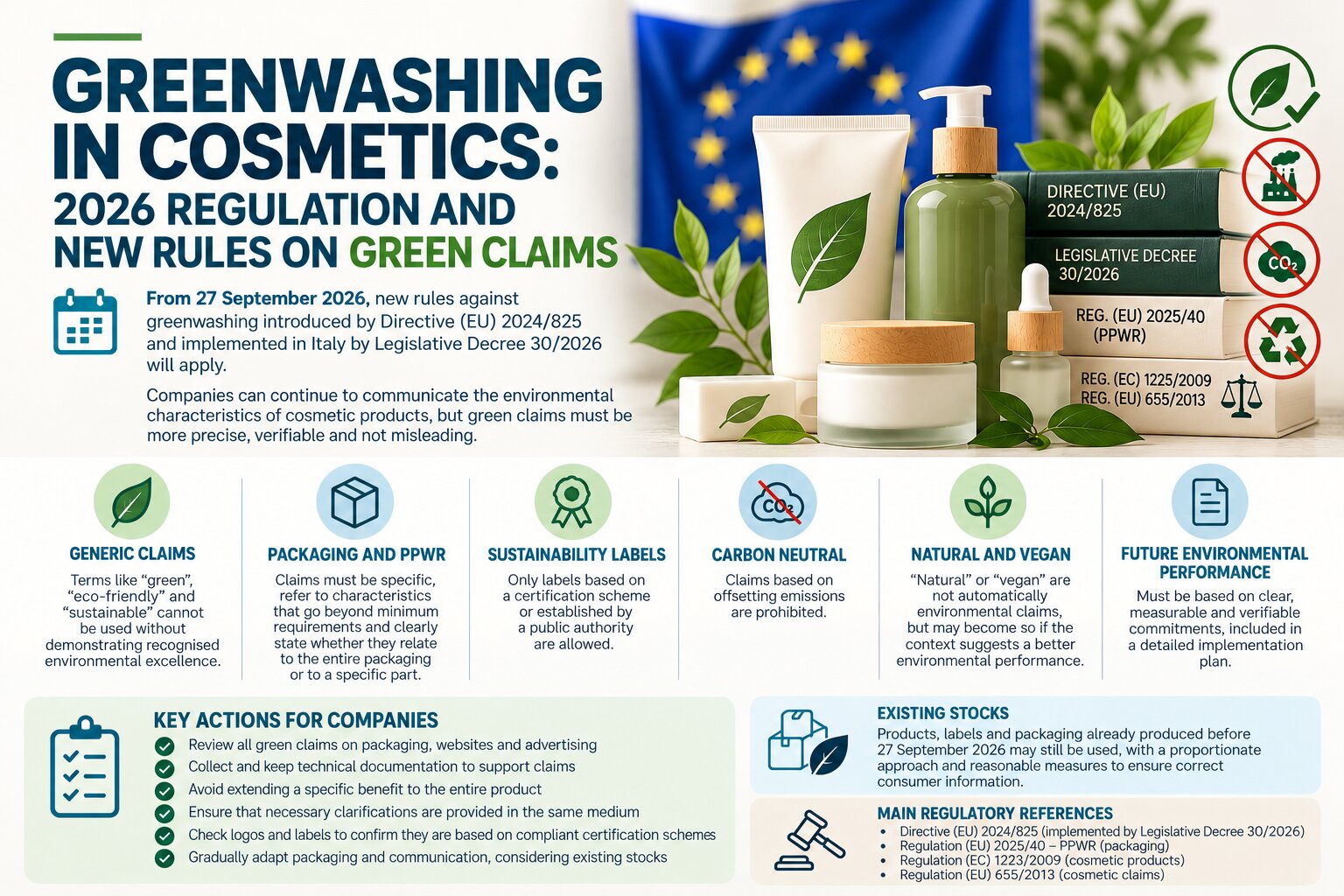
Greenwashing in Cosmetics: 2026 Regulation and New Rules on Green Claims
Sustainability has become one of the most widely used themes in cosmetic product communication. Expressions such as “green”, “eco-friendly”, “sustainable”, “carbon neutral”, “eco packaging” or “environmentally friendly” increasingly appear on packaging, websites, e-commerce platforms, social media and advertising materials.
From 27 September 2026, however, the regulatory framework has changed significantly. With the application of the provisions introduced by Directive (EU) 2024/825 and transposed into Italian law by Legislative Decree No. 30 of 20 February 2026, the rules against greenwashing have been strengthened and new commercial practices have been classified as misleading.
For the cosmetics sector, the impact is particularly relevant. Green claims must now be assessed not only under the rules governing cosmetic claims, but also under legislation on unfair commercial practices and, where packaging is concerned, under Regulation (EU) 2025/40 on packaging and packaging waste (PPWR).
This means that claims, symbols, logos, certifications, packaging descriptions and sustainability-related communications should all be reviewed more carefully.
Greenwashing: what changes from 27 September 2026
Directive (EU) 2024/825, on empowering consumers for the green transition, amended the European framework on unfair commercial practices and consumer rights.
In Italy, the Directive was transposed through Legislative Decree No. 30 of 20 February 2026. The new provisions apply from 27 September 2026.
The objective is not to prohibit every reference to sustainability. Companies may continue to communicate the environmental characteristics of their products, but they must do so in a more specific, transparent and verifiable manner.
The underlying principle is that the scope of the claim should be proportionate to the evidence available. The more a statement suggests an overall environmental superiority of a product, the stronger and broader the supporting evidence will need to be.
What are green claims and environmental claims?
The legislation defines an environmental claim as any non-mandatory message or representation which states or implies that a product, brand or trader has a positive or zero impact on the environment, is less damaging to the environment than other products, brands or traders, or has improved its environmental impact over time.
The concept is broad and includes not only written statements, but also graphic or symbolic representations, product names, brand names and other elements of commercial communication.
This is particularly relevant in the cosmetics sector, where green communication is often built around colours, leaves, botanical imagery, references to nature, logos and terms such as “eco”, “green” or “planet friendly”.
The assessment must therefore consider the overall impression conveyed to the average consumer.
A green package or the image of a leaf does not automatically constitute a generic environmental claim. However, these elements may contribute to creating an implicit environmental message when used in a context that suggests better environmental performance.
Do “natural” and “vegan” mean sustainable?
Not necessarily.
The term “vegan”, when considered on its own, concerns a characteristic of the product and does not necessarily refer to its environmental impact. Similarly, the fact that an ingredient is “natural” does not automatically mean that it is more sustainable than a synthetic ingredient.
The issue arises when these terms are presented within a broader communication suggesting a direct environmental benefit, for example:
“Vegan, therefore better for the planet”
or
“Natural and sustainable formula.”
In such cases, the communication may acquire an environmental meaning and should be assessed and substantiated accordingly.
Naturalness and sustainability should therefore not be treated as equivalent concepts.
Generic claims: caution with “green”, “eco” and “sustainable”
One of the most important changes concerns generic environmental claims.
Directive (EU) 2024/825 refers to expressions such as “environmentally friendly”, “eco-friendly”, “green”, “ecological”, “climate friendly”, “biodegradable” and “biobased”.
A generic environmental claim is prohibited where the trader cannot demonstrate recognised excellent environmental performance relevant to the claim.
For a cosmetic product, statements such as “green cosmetic”, “eco-friendly product” or “environmentally friendly” therefore require particular caution.
Even broader terms such as “sustainable”, “responsible” or “conscious” require additional attention because they may relate not only to environmental characteristics but also to social aspects. A good environmental performance alone may therefore not be sufficient to support such a broad message.
However, the legislation introduces an important distinction: where the environmental benefit is specified in clear and prominent terms on the same medium, the claim may no longer be considered generic.
For example, instead of:
“Sustainable packaging”
a more specific claim may be:
“Bottle made with 50% recycled plastic”
provided that the statement is accurate and properly substantiated.
The clarification must also be clearly visible and directly connected to the main claim.
A broad statement appearing on the front of the packaging should not be explained only through a difficult-to-find webpage or an unrelated statement on the back of the pack.
If additional information is necessary for the consumer to correctly understand the claim, the connection should be clear within the same communication medium.
An environmental benefit cannot be extended to the entire cosmetic product
A specific environmental characteristic should not be presented as if it applied to the entire product.
For example, a bottle containing recycled plastic may have a particular environmental characteristic, but this does not automatically mean that the whole cosmetic product can be described as “sustainable”.
Similarly, the presence of an ingredient sourced from a certified supply chain does not, by itself, demonstrate that the entire formula or finished product has a better environmental performance.
It is therefore essential to identify exactly what the claim refers to:
ingredient, formula, packaging, manufacturing process, production site, company or the product as a whole.
Even a technically correct statement may become misleading if it is emphasised in a way that suggests an environmental superiority broader than the benefit actually demonstrated.
Sustainable packaging and the PPWR
Packaging is one of the areas where green claims are most frequently used.
Common statements include “sustainable packaging”, “100% recyclable”, “plastic free”, “made with recycled material” or “less plastic”.
These claims should now also be considered in light of Regulation (EU) 2025/40 – PPWR.
Article 14 provides that environmental claims concerning packaging characteristics already regulated by the PPWR may only relate to characteristics that exceed the applicable minimum legal requirements.
The claim must also specify whether it relates to the entire packaging unit, part of the packaging, or all packaging placed on the market by the economic operator.
Compliance must be demonstrated within the technical documentation relating to the packaging.
For example, if only the bottle contains 70% recycled plastic while the cap is excluded, a statement such as:
“Bottle made with 70% recycled plastic – cap excluded”
is more precise than:
“Packaging made with 70% recycled material.”
Particular attention should also be given to the term “recyclable”.
Technical recyclability does not necessarily mean that the packaging is effectively recyclable under real-life collection, sorting and recycling conditions in the relevant market.
What evidence is required for a green claim?
Not all environmental claims require the same level of supporting evidence.
For a specific statement, such as the percentage of recycled material in a bottle, robust technical documentation directly relating to that characteristic may be sufficient.
However, where a company claims an overall better environmental performance of the cosmetic product, the assessment must be broader and may require a life-cycle approach based on scientifically robust methodologies.
A complete Life Cycle Assessment is therefore not necessarily required for every specific environmental claim.
However, the broader the environmental superiority claimed, the broader the assessment and supporting evidence are expected to be.
Another important concept is burden shifting.
An improvement in one environmental parameter should not be presented as an overall environmental advantage if it causes a significant deterioration in another environmental area.
For example, a reduction in CO₂ emissions should not automatically be presented as an overall environmental improvement if it results in a significant increase in water use, toxicity, biodiversity impact or other relevant environmental burdens.
Green logos and sustainability labels
The new rules also apply to sustainability labels.
A sustainability label may not be displayed unless it is based on a compliant certification scheme or established by a public authority.
This point is particularly relevant for cosmetic companies because many brands use self-created badges or logos containing expressions such as:
“Green Formula”, “Eco Choice”, “Planet Friendly” or “Sustainable Beauty”.
However, not every leaf, water drop or environmental-looking icon automatically constitutes a sustainability label.
The assessment depends on the overall impression created by the graphic design, positioning, text and consumer perception.
For example, an icon used only to explain how to refill a bottle may serve an instructional purpose and should not necessarily be considered a sustainability label.
The situation is different where a badge resembles an official seal or contains words such as “approved”, “verified” or “certified”, which may suggest that an independent assessment or certification has taken place.
Even a legitimate sustainability certification does not represent a general safe haven.
The certified benefit cannot be extended beyond the actual scope of the certification.
Carbon neutral claims and carbon offsetting
The new legislation prohibits claims presenting a product as “carbon neutral”, “climate neutral” or as having a reduced or positive climate impact where the claim is based on greenhouse gas offsetting outside the product’s value chain.
Purchasing carbon credits or funding reforestation projects cannot therefore be used to give consumers the impression that the cosmetic product itself has a neutral climate impact.
Companies may still communicate their investments in environmental projects, provided that the communication accurately describes what has actually been done and does not transform an offsetting initiative into an environmental characteristic of the product itself.
Future environmental targets
Statements such as “carbon neutral by 2030” or “100% sustainable packaging by 2035” also require careful assessment.
Claims relating to future environmental performance must be supported by clear, objective, publicly available and verifiable commitments set out in a detailed and realistic implementation plan.
The plan should contain measurable targets, defined timelines and the resources and actions necessary to achieve them.
Regular verification by an independent third-party expert is also required, and the findings should be made available to consumers.
Marketing communication therefore cannot be based solely on an environmental ambition.
There must be a concrete framework showing how the objective will be achieved and how progress will be monitored.
Greenwashing and cosmetic claims: two levels of assessment
For cosmetic products, the new provisions do not replace the sector-specific legislation already in force.
Article 20 of Regulation (EC) No 1223/2009 prohibits the use of text, names, trademarks, images or other signs that attribute characteristics or functions to cosmetic products which they do not have.
Regulation (EU) No 655/2013 also establishes the common criteria for the justification of cosmetic claims:
legal compliance, truthfulness, evidential support, honesty, fairness and informed decision-making.
Environmental claims should therefore be assessed at two different levels.
First, the claim must be accurate and adequately substantiated under cosmetics legislation.
Second, the way in which the environmental benefit is communicated must comply with the new rules against greenwashing.
It is therefore no longer sufficient to ask:
“Can I prove what I am claiming?”
Companies should also ask:
“Does the wording of the claim communicate exactly what the available evidence demonstrates?”
Existing stocks and packaging already produced
One of the most sensitive issues concerns products, labels and packaging manufactured before 27 September 2026.
The Italian Ministry of Enterprises and Made in Italy (MIMIT) FAQs updated on 1 October 2026 clarify that products already manufactured or packaged before that date may continue to be marketed, provided that the earlier production or packaging date can be demonstrated and reasonable and proportionate measures are adopted to correct any non-compliant information.
Packaging and labels already produced or purchased before 27 September 2026 may also fall within old stock situations and may continue to be used under certain conditions.
The Italian authorities refer, as an indicative timeframe, to a period of approximately six months for stock depletion, although the circumstances of each case should be considered, including stock volumes, packaging production cycles and orders already placed.
Cosmetic companies should therefore retain evidence relating to purchase orders, quantities, packaging production dates and the measures adopted to progressively update their communications.
Digital content, which can generally be modified more rapidly, should instead be reviewed without unnecessary delay.
How to review green claims for a cosmetic product
An effective compliance review should begin by mapping all environmental communications appearing on packaging, labels, websites, e-commerce platforms, social media and advertising materials.
For each claim, the company should identify exactly what the statement refers to and collect the evidence demonstrating its accuracy.
The review should verify whether:
- the scope of the claim is proportionate to the available evidence;
- it is clear whether the claim refers to an ingredient, formula, packaging or the entire product;
- any necessary clarification is provided within the same communication medium;
- a specific benefit is not extended to the whole cosmetic product;
- logos and badges do not imitate non-existent certifications;
- the message is consistent across packaging, websites and other communication channels.
Conclusions
From 27 September 2026, environmental communication for cosmetic products requires a more structured compliance assessment.
The new rules address generic environmental claims, sustainability labels, climate-related claims, future environmental targets and the presentation of specific environmental benefits as if they applied to the entire product.
These requirements apply alongside existing cosmetic claims legislation and, for packaging, the new PPWR framework.
A practical review can be summarised through four questions:
What environmental benefit am I communicating? What part of the product does it refer to? What evidence do I have? Does the consumer receive exactly the message that this evidence allows me to support?
Communicating sustainability is not prohibited.
However, environmental claims must be specific, proportionate and substantiated, avoiding situations where a limited positive characteristic is transformed into a broader environmental promise that cannot actually be demonstrated.